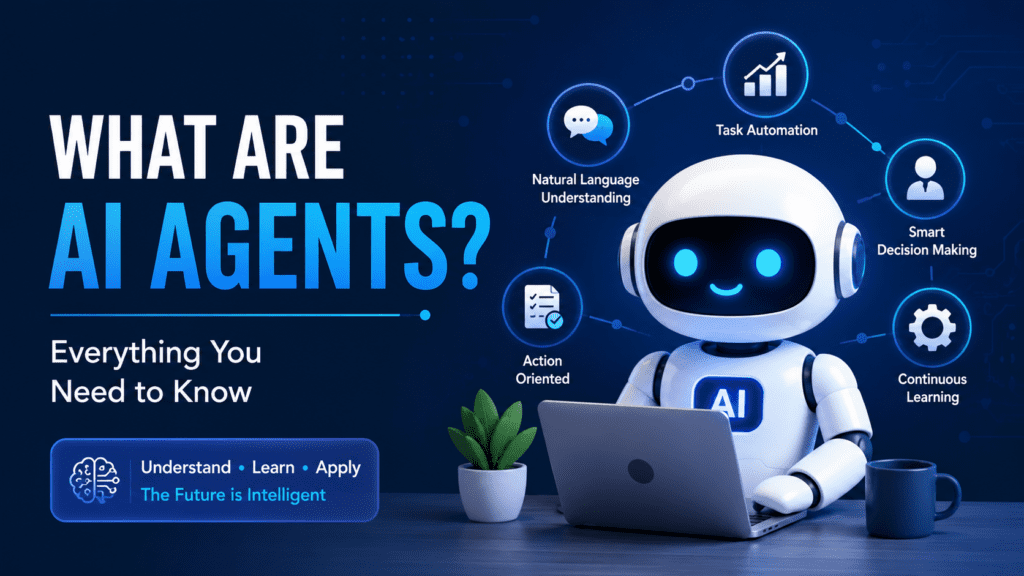
In this blog, we will understand what AI agents are, how they work, their types, benefits and real-world applications. What Are AI Agents?

AI agents are software systems that use artificial intelligence to perform tasks and solve problems. They can observe their environment, process information and make decisions based on the data available. AI are are useful in
Digital marketing in 2026 Unlike traditional software that only follows fixed instructions, AI agents can adapt and respond according to different situations. They are capable of learning from previous interactions and improving their performance over time. For example, ChatGPT, Siri and Google Assistant are examples of AI agents that help users by answering questions and completing various tasks.
How Do AI Agents Work?
AI agents work by collecting information, analyzing it and taking appropriate actions. They use technologies such as machine learning, natural language processing and large language models to understand user inputs and provide relevant responses. The working process of AI agents can be divided into four steps:
1. Data Collection
AI agents collect information from different sources such as user queries, websites, databases and sensors.
2. Processing Information
The collected data is analyzed using artificial intelligence algorithms to understand the context and identify patterns.
3. Decision Making
Based on the information available, AI agents decide what action should be taken to achieve the desired result.
4. Taking Action
After making a decision, the AI agent performs the required task such as answering a question, sending an email or generating a report.
Types of AI Agents
There are different types of AI agents depending on their capabilities and working methods.
Simple Reflex Agents
Simple reflex agents perform actions based on predefined rules. They do not remember previous events and only respond to current situations. For example, automatic doors that open when someone approaches.
Model-Based Agents
These agents maintain information about previous events and use it to make better decisions. For example, navigation systems that remember routes and traffic conditions.
Goal-Based Agents
Goal-based agents focus on achieving specific objectives. They evaluate different options and select the best action. For example, AI assistants that help users schedule meetings and manage tasks.
Learning Agents
Learning agents continuously improve their performance by learning from experiences and feedback. For example, recommendation systems used by Netflix, YouTube and Amazon.
Benefits of AI Agents
AI agents provide several advantages to businesses and individuals.
Saves Time
AI agents can automate repetitive tasks such as answering customer queries, generating reports and managing emails. This helps save time and increase efficiency.
Improves Productivity
Businesses can handle multiple tasks simultaneously with the help of AI agents. This improves productivity and reduces manual effort.
Available 24/7
Unlike humans, AI agents can work continuously without breaks. This helps businesses provide support to customers at any time.
Reduces Human Errors
AI agents perform tasks with high accuracy and consistency. This reduces mistakes and improves overall performance.
Better Customer Experience
AI-powered chatbots and virtual assistants provide instant responses and personalized experiences to users.
Real-Life Applications of AI Agents
AI agents are being used in different industries such as healthcare, education, finance and digital marketing.
Customer Support
Companies use AI chatbots to answer customer queries and provide instant support.
Healthcare
AI agents help doctors analyze medical reports and assist in diagnosis.
Education
Educational platforms use AI agents to provide personalized learning experiences and answer student questions.
Finance
Banks and financial institutions use AI agents to detect fraud and manage customer services.
Digital Marketing
AI agents help marketers create content, analyze data, manage advertisements and improve SEO performance.
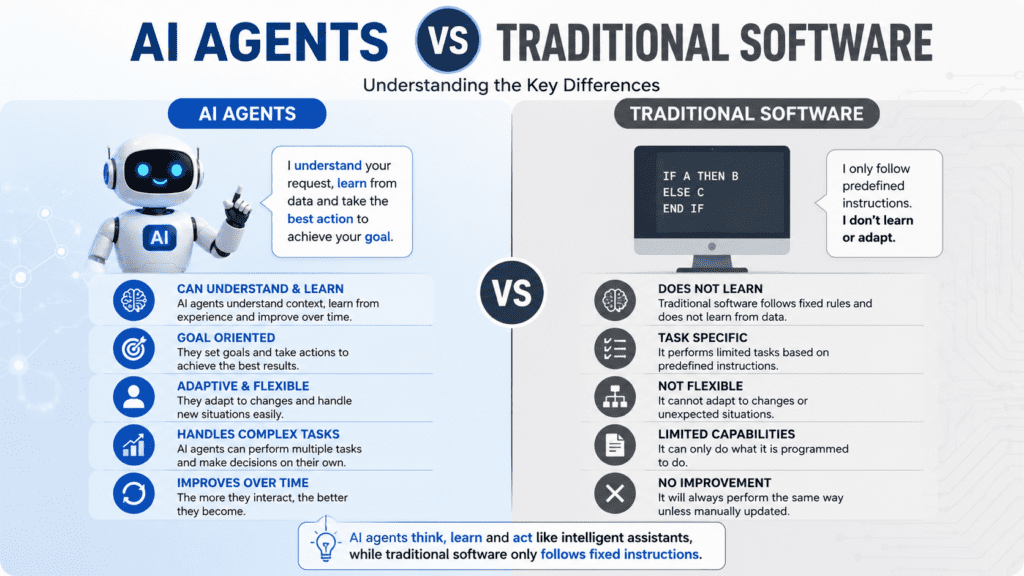
AI Agents vs Traditional Software
Traditional software follows fixed instructions and performs limited tasks. On the other hand, AI agents can understand data, learn from experiences and adapt to different situations. For example, a calculator only performs calculations according to commands. However, an AI agent can understand a user’s request, provide explanations and suggest solutions. This flexibility makes AI agents more powerful and useful for modern businesses.
Future of AI Agents
The future of AI agents looks promising. As artificial intelligence continues to evolve, AI agents are becoming smarter and more capable. In the coming years, AI agents are expected to perform more complex tasks such as managing businesses, handling customer interactions and assisting professionals in different industries. Many companies are already investing in AI technologies to improve efficiency and stay competitive in the digital world.
Conclusion
AI agents are intelligent software programs that can perform tasks, make decisions and learn from experiences. They are transforming industries by automating processes and improving productivity. From customer support to digital marketing, AI agents are helping businesses save time and provide better services. As technology continues to advance, the use of AI agents will continue to increase, making them an important part of the future.
Interested in learning?
If you want to learn about emerging technologies such as AI, digital marketing, SEO and automation, staying updated with the latest industry trends is important. Institutions such as
Vidya Sarthi Institute of Digital Education help students and professionals understand modern digital skills and prepare for future opportunities in the digital world.