What Is PPC in Digital Marketing? A Simple Guide for Beginners
Quick Read Summary: What Is PPC in Digital Marketing?
PPC stands for Pay-Per-Click, a type of online advertising where businesses generally pay when someone clicks on their ad.
PPC helps businesses promote their products or services on platforms like search engines and social media. Businesses can target specific keywords and audiences, set budgets, and track campaign performance.
Key Takeaways
PPC means Pay-Per-Click.
Businesses use paid ads to reach their target audience.
Keywords help show ads to people searching for relevant terms.
PPC can provide quick online visibility.
Businesses can track clicks, impressions, leads, sales, and other results.
Common types include Search Ads, Display Ads, Shopping Ads, and Social Media Ads.
PPC and SEO are different: PPC provides paid visibility, while SEO focuses on organic search visibility.
Learning PPC is a useful skill for anyone planning a career in digital marketing.
In short: PPC is about reaching the right audience through paid advertising, controlling your budget, and measuring the results.
Table of Contents
If you have ever searched for something on Google and noticed some websites appearing at the top with a small “Sponsored” or “Ad” label, those results are usually part of PPC advertising.
PPC is one of the important parts of digital marketing. It helps businesses reach people who are already searching for their products or services online.
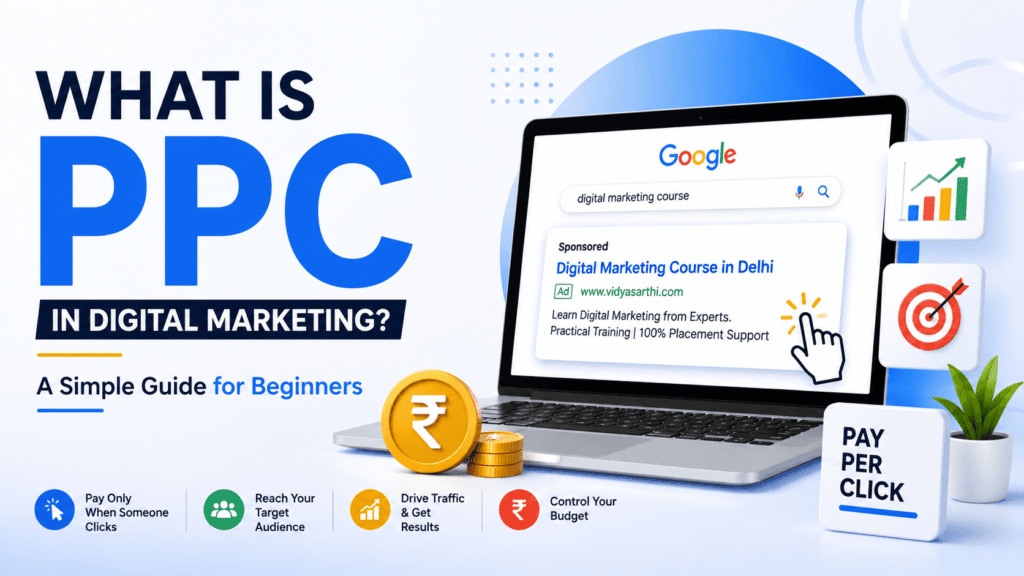
For example, if you search for “digital marketing course in Delhi”, you may see advertisements from different institutes at the top of Google. Businesses pay to show these ads to potential customers. This type of advertising is called PPC, or Pay-Per-Click.
In this blog, we will understand what PPC is, how it works, its benefits, different types of PPC advertising, and why businesses use it.
What Is PPC in Digital Marketing?
PPC stands for Pay-Per-Click.
PPC is a type of online advertising where an advertiser generally pays when someone clicks on their advertisement.
In simple words, businesses use PPC to promote their products, services, website, or offers on online platforms. Instead of waiting for people to find their website naturally, businesses can use paid advertisements to reach their target audience.
For example, suppose you run a digital marketing institute in Delhi and want more students to visit your website.
You can create a Google ad for keywords such as:
Digital marketing course in Delhi
Digital marketing institute near me
Best digital marketing course
Digital marketing classes
When a person searches for these terms, your advertisement may appear on the search results page.
If the person clicks on your ad, you may have to pay a certain amount for that click.
This is why it is called Pay-Per-Click.
How Does PPC Work?
PPC may look simple from the outside, but there are different steps involved in running a PPC campaign.
The basic process looks like this:
Business → Creates Ad → Selects Target Audience/Keywords → Ad Appears → User Clicks → Business Pays
Let us understand this with an example.
Imagine you own a website that sells running shoes.
You want to attract people who are searching for running shoes online.
First, you create a PPC campaign.
Then, you select relevant keywords such as:
Buy running shoes
Best running shoes
Running shoes online
Sports shoes for running
When someone searches for one of these keywords, your advertisement can become eligible to appear.
The user sees the advertisement and may click on it. The user is then taken to your website or landing page.
If the goal of your campaign is sales, the person may purchase the product.
So, PPC can help businesses bring the right people to their website quickly.
What Are the Main Parts of a PPC Campaign?
A PPC campaign has several important parts. Understanding these parts is useful if you want to learn PPC properly.
1. Keywords
Keywords are words or phrases that people type into search engines.
For example:
“Best digital marketing course in Mumbai”
can be a keyword.
Choosing the right keywords is important because your advertisements should reach people who are interested in what you are offering.
2. Advertisement
The advertisement is the message that users see.
A PPC ad can include a headline, description, website link, offer, or call to action.
For example:
Learn Digital Marketing in Mumbai
Join practical digital marketing classes and build industry-ready skills.
The advertisement should be clear and relevant to the audience.
3. Target Audience
PPC allows businesses to target specific types of people depending on the advertising platform and campaign.
Businesses can target audiences based on factors such as location, interests, search behaviour, and other available targeting options.
For a local business, location targeting can be very useful.
For example, a coaching institute in Pune may want to show its advertisements mainly to people in Pune instead of targeting the whole country.
4. Landing Page
When a person clicks on a PPC advertisement, they are usually taken to a webpage. This page is called a landing page.
The landing page should match the advertisement.
For example, if the ad says “Digital Marketing Course in Delhi”, the user should ideally reach a page that provides information about that particular course.
A relevant landing page can make it easier for the visitor to take the next action.
What Are the Types of PPC Advertising?
PPC is not limited to search advertisements. Businesses can use different types of paid advertising depending on their goals.
Search Ads
Search ads appear on search engine results pages when users search for particular terms.
For example, someone searching for “best gym near me” may see advertisements from local gyms.
Search ads are useful because they can reach people who are already searching for a product or service.
Display Ads
Display advertising uses visual advertisements such as banners and images.
These ads can appear across websites and other online platforms that support display advertising.
Display ads can help businesses increase awareness and reach a larger audience.
Shopping Ads
Shopping ads are commonly used by e-commerce businesses.
They can show product information such as the product name, image, and price.
For example, if you search for a particular type of laptop, you may see product advertisements along with their prices.
Social Media Ads
Businesses can also use paid advertising on social media platforms.
Platforms such as Instagram and Facebook allow businesses to promote their products, services, content, or offers to selected audiences.
For example, a clothing brand can run an advertisement for its new collection and target people who may be interested in fashion.
What Are the Benefits of PPC?
PPC has become an important part of digital marketing because it can provide several benefits to businesses.
1. Quick Visibility
SEO can take time to build. PPC can help businesses get visibility through paid advertisements much faster.
Once a campaign is approved and starts running, the advertisement can become visible to the targeted audience.
2. Targeted Advertising
PPC allows businesses to target specific audiences.
This means a business does not necessarily have to show its advertisement to everyone.
It can focus on people who are more relevant to its products or services.
3. Helps Generate Website Traffic
PPC advertisements can bring visitors to a website.
For businesses that want more enquiries, registrations, sales, or website visits, paid advertising can be a useful marketing method.
4. Measurable Results
One major advantage of digital advertising is that businesses can track different campaign metrics.
For example, they can check information such as:
Number of clicks
Impressions
Click-through rate
Cost
Conversions
Leads
Sales
This data helps marketers understand how their campaigns are performing.
5. Budget Control
Businesses can set budgets for their advertising campaigns.
This is useful for small businesses because they can decide how much they want to spend instead of spending without a limit.
PPC vs SEO: What Is the Difference?
PPC and SEO are both important parts of digital marketing, but they work differently.
PPC is paid advertising. Businesses pay to show advertisements and attract visitors.
SEO, or Search Engine Optimization, focuses on improving a website so that it can appear organically in search engine results.
For example, if a company pays to appear at the top of Google, that can be PPC.
If a website appears in the organic search results because of its SEO efforts, that is SEO.
Both methods can be useful. PPC can provide faster paid visibility, while SEO focuses on building organic visibility over time.
Why Should You Learn PPC?
PPC is an important skill for digital marketers because many businesses use paid advertising to promote their products and services.
A digital marketer may work on activities such as:
Keyword research
Campaign creation
Ad copy
Audience targeting
Budget management
Campaign optimisation
Tracking results
Generating leads and sales
Learning PPC can therefore help students and marketing professionals understand how online advertising works in a practical way.
However, learning PPC is not only about creating an advertisement. A good marketer should also understand the business goal behind the campaign and use data to improve performance.
Conclusion
PPC in digital marketing means Pay-Per-Click advertising, where businesses use paid advertisements to reach their target audience and generally pay when users click on their ads.
From Google search ads to display, shopping, and social media advertising, PPC provides businesses with different ways to promote their products and services online.
The most important thing to remember is that PPC is not simply about spending money on advertisements. It is about reaching the right audience, using relevant keywords and messages, controlling the budget, and measuring the results.
If you want to build a career in digital marketing, understanding PPC can be a useful step.
Want to Learn Digital Marketing?
If you want to learn PPC, SEO, social media marketing, Google Ads, and other important areas of digital marketing, Vidya Sarthi can help you build your digital marketing knowledge with practical learning.
Start learning digital marketing, understand how online advertising works, and develop skills that can help you move towards a career in the digital marketing industry.
Join Vidya Sarthi and take your first step towards learning digital marketing.